Ideas Shaping the Future of AI-First Business
Empirical analysis, transition frameworks, and strategic briefings for enterprise leadership.

Ecommerce Agency vs Freelancer vs In-House Team: Full Breakdown
| Option | Typical Cost | Team Size | Speed to Hire | Best For | |------------|------------------|---------------|-------...


How to choose an ecommerce consultancy in the UK
Use this checklist before shortlisting any ecommerce consultancy in the UK. - Platform experience matches your current or target platform (Shopify Plus, Magento, BigCommerce, etc.) - Industry experience includes clients in your sector from the last 18 months - UK market knowledge covers VAT, seasonal trading, delivery expectations, and returns - Service scope is defined in writing with deliverables and timelines - Case studies are verifiable and reference contacts are provided - Named team members are confirmed before signing - Pricing is clearly structured with no ambiguous escalation clauses - The consultancy can articulate what they will not do If a prospective agency cannot satisfy all eight of these points before you sign, keep looking.

AI Security in 2026: What Every Organization Needs to Know
AI and agentic AI security in 2026 is no longer optional. Agentic systems that plan, act, and execute tasks autonomously have expanded the attack surface far beyond what traditional cybersecurity frameworks were built to handle. Prompt injection, model poisoning, data exfiltration, and privilege escalation are the threats doing real damage right now. The fix isn't exotic. It's least-privilege access, input validation, human-in-the-loop controls for high-stakes actions, runtime monitoring, and governance that actually has an owner. Organizations still treating AI deployment as a product decision rather than a security event are the ones getting caught out.

How We Cut Cart Abandonment with AI for a UK DTC Brand
We cut cart abandonment by pairing AI demand forecasting with smarter stock positioning for a UK DTC brand running around 400 SKUs. The fix wasn't a s...
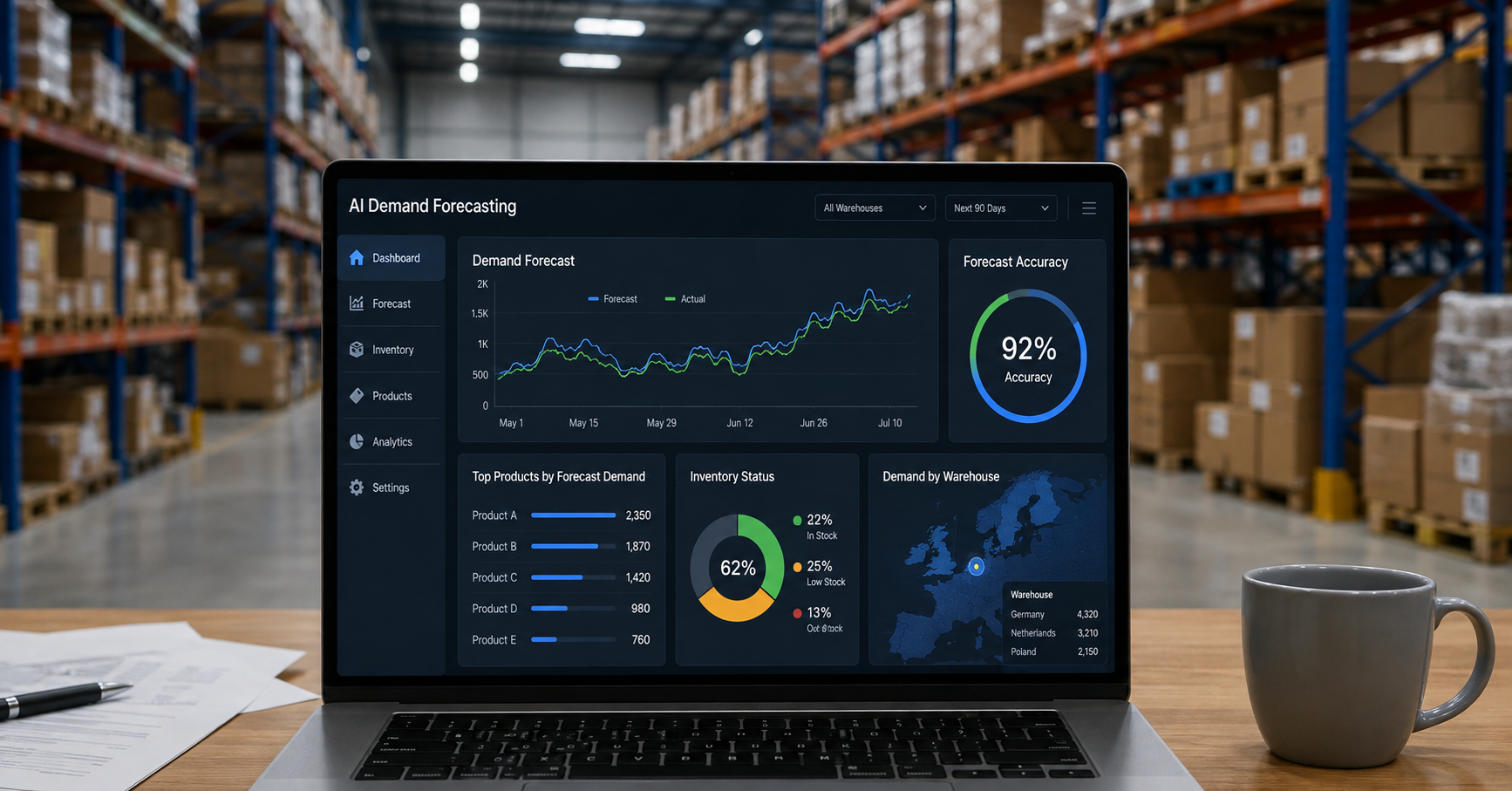
AI Demand Forecasting for Ecommerce Inventory
AI demand forecasting uses machine learning to predict what you'll sell, when, and where, by reading patterns across sales, seasons, and outside signa...

AI in Ecommerce: 8 Ways It's Changing the Game
AI helps ecommerce businesses grow by automating personalization, customer service, pricing, inventory management, fraud detection, marketing, and visual search. Brands that adopt AI tools see measurable improvements in conversion rates, customer retention, and operational efficiency. Xorblin helps ecommerce businesses build and deploy custom AI solutions tailored to their specific needs. The ecommerce brands quietly pulling ahead right now share one thing in common. They're not just selling better. They're operating smarter, using AI to do the heavy lifting across nearly every part of their business. This isn't hype. AI has moved from "nice to have" to a genuine competitive edge. The brands that figure this out early get compounding advantages. Faster decisions, lower costs, better customer experiences. The ones that wait? They're catching up to a moving target. This post breaks down exactly how AI is reshaping ecommerce, from the front-end experience your customers see to the back-end operations they don't. You'll also see how Xorblin helps ecommerce businesses build and implement these systems without needing an in-house AI team. Here's what that looks like in practice.

Headless Commerce Explained: Is It Worth It for Mid-Size Brands?
**What is headless commerce?** Headless commerce is an architecture that separates a store's front end from its back end, connecting the two through APIs instead of a single fused platform. **Is it worth it for mid-size brands?** Usually only once a brand is pushing past the limits of a standard platform theme, selling across several channels or markets, or losing revenue to slow, inflexible storefronts. Below roughly €3–5M in EU online revenue, the added engineering overhead rarely pays for itself yet.

How Much Does Custom Ecommerce Development Cost in the UK (2026)?
Custom ecommerce development in the UK typically costs between £4,000 and £45,000 for most businesses, though projects range from £1,800 for a basic s...

How Much Does Custom Ecommerce Development Cost in the UK (2026)?
Custom ecommerce development cost in the UK typically runs from £15,000 to £400,000+ depending on scope. A template-based Shopify build costs £15,000–£40,000, custom Shopify Plus development £40,000–£150,000+, a platform migration £75,000–£250,000+, and a headless or composable build £100,000–£400,000+. Monthly retainers land between £4,000 and £40,000+.
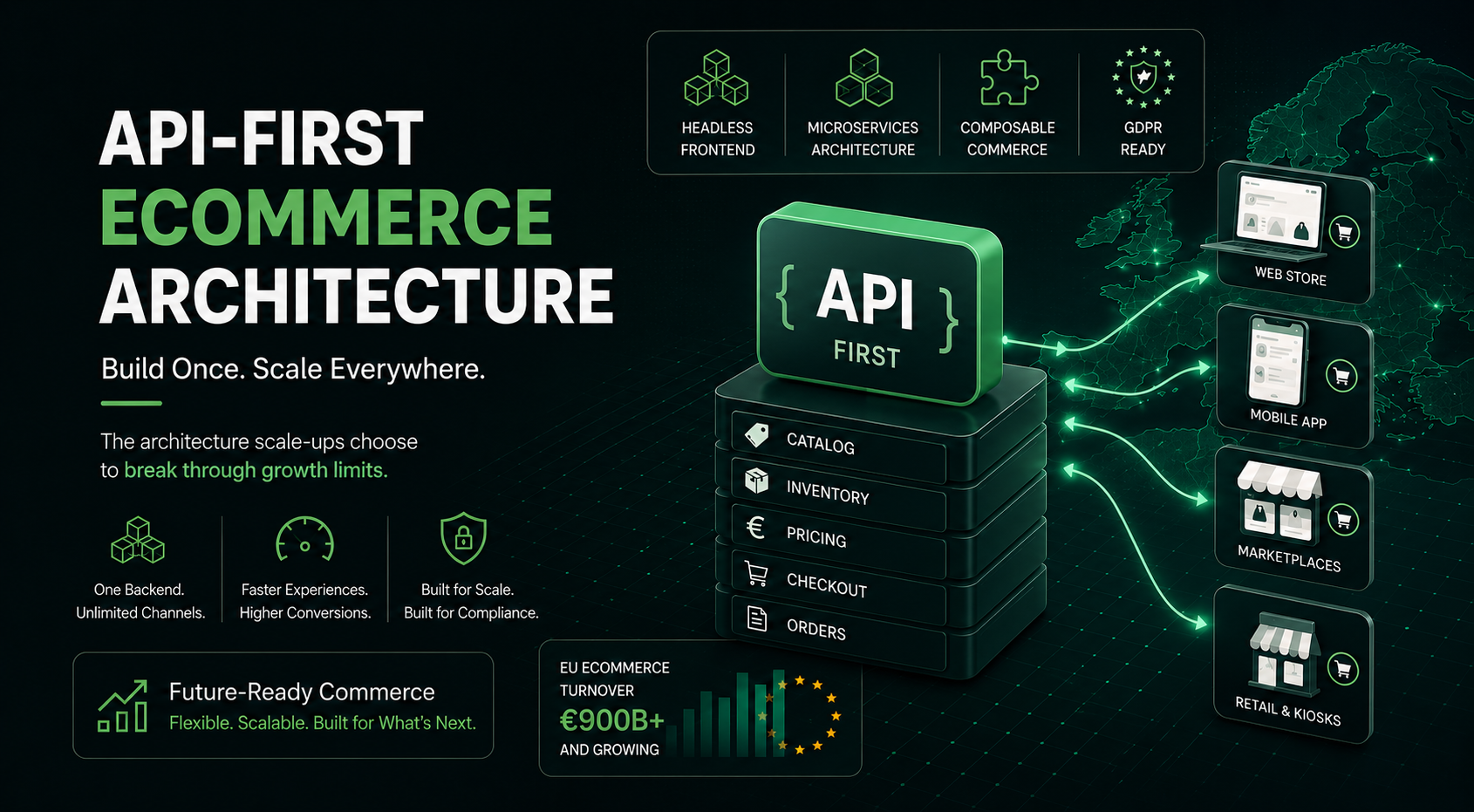
API-First Ecommerce Architecture for Scale-Ups
API-first ecommerce architecture is a way of building your store where every function, from catalog to checkout, lives behind an API before any storefront gets built. Your front end, mobile app, and marketplace channels all connect to that single backend, so you can change one without breaking the others. Scale-ups reach for it when platform limits, multi-channel selling, or traffic spikes start costing real revenue, often somewhere past €5M to €10M in annual online sales. If you're patching gaps with apps and workarounds just to run normal operations, you've likely already outgrown the monolith.
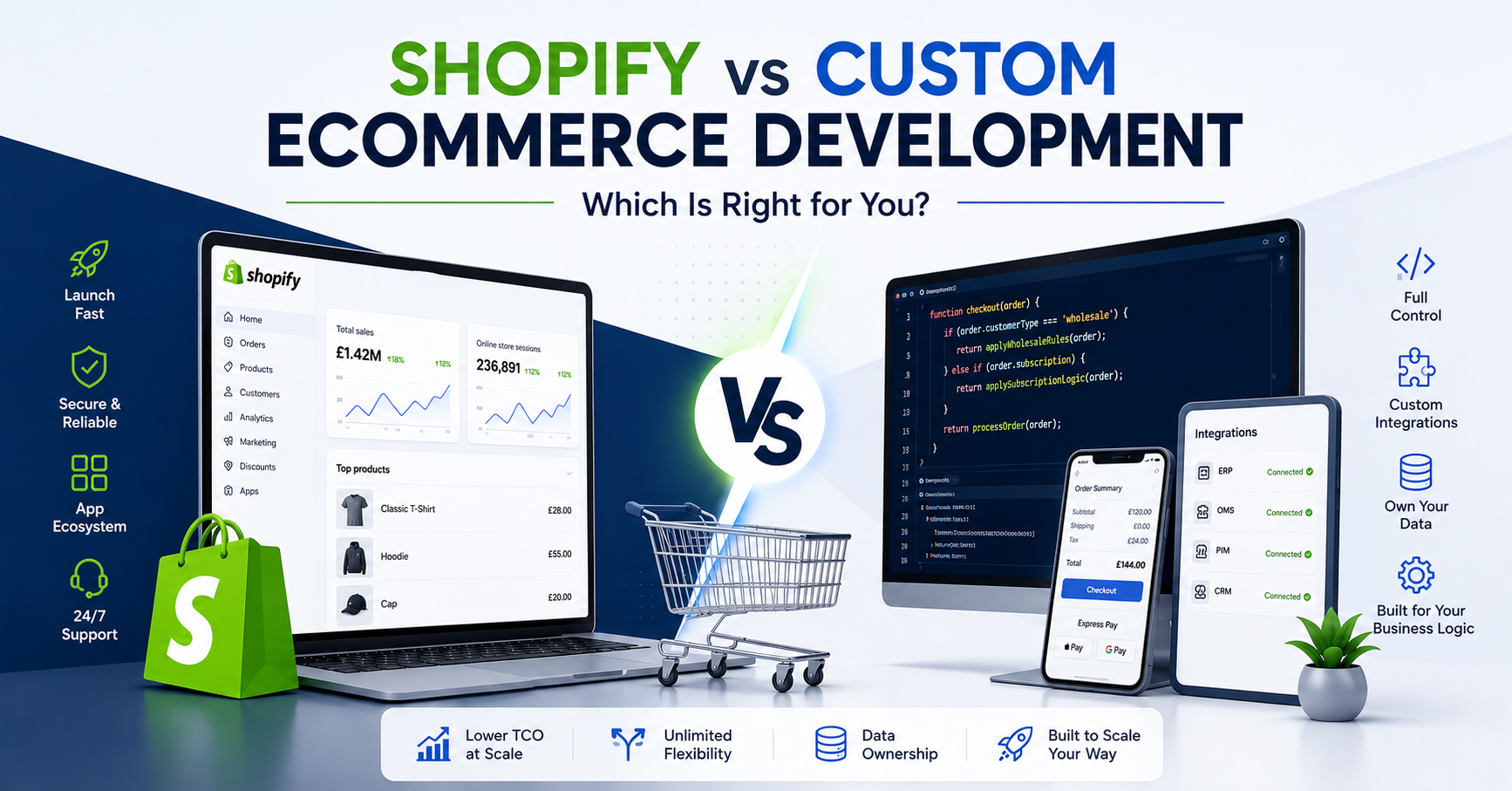
Custom Ecommerce Development vs Shopify Guide
**Shopify or custom ecommerce, which should you choose?** Shopify is the right call for most brands under roughly £2M to £5M in revenue, or any team that needs to launch fast with standard retail logic. Custom ecommerce development wins when your business model, integrations, or scale outgrow what a hosted platform can flex around. If you're fighting the platform to run your own business, that's usually the signal to build. **The short version**: start on Shopify when speed and simplicity matter most. Move toward custom when the cost of workarounds, transaction fees, and lost flexibility starts to exceed the cost of owning your stack.
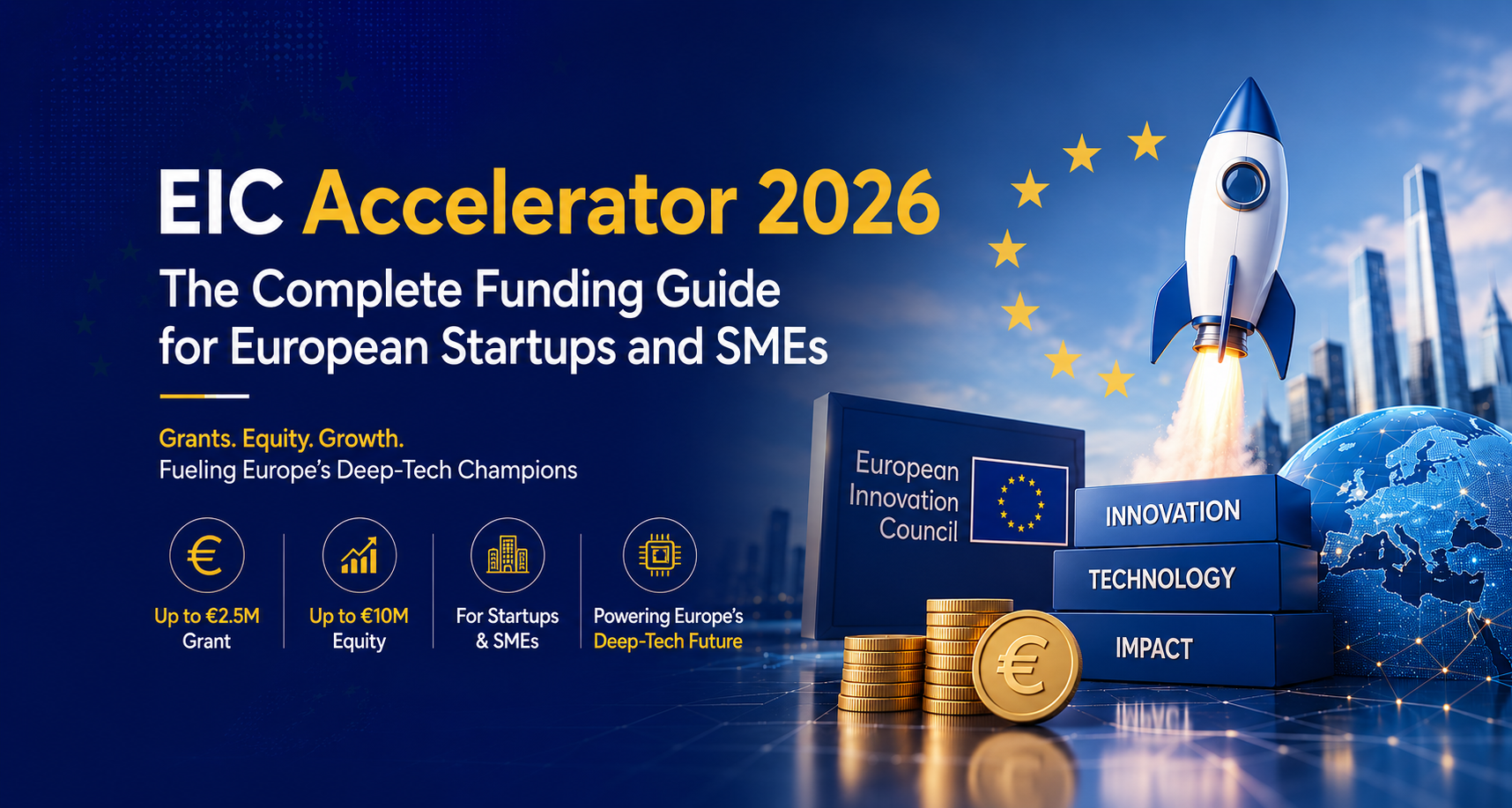
EIC Accelerator 2026: The Complete Funding Guide for European Startups
- **What is it?** The EIC Accelerator is Europe's main grant and equity funding programme for deep-tech startups and SMEs. - **How much?** Up to €2.5M non-dilutive grant plus up to €10M equity. Companies in strategic sectors can access up to €30M equity-only through STEP Scale-Up. - **Who qualifies?** For-profit SMEs with under 250 employees, registered in an EU member state or Horizon Europe associated country, with technology at TRL 5 or above. - **2026 budget?** €634 million total: €414M for the Open call and €220M split across five thematic Challenges. - **Biggest 2026 change?** Six full-proposal cut-offs per year, up from two. A mandatory online technical due diligence interview is now part of the full-proposal stage. - **Success rate?** Roughly 3% end-to-end. Competitive, but very achievable with solid preparation. - **Where to apply?** [EIC Accelerator portal](https://eic.ec.europa.eu/eic-funding-opportunities/eic-accelerator_en)

Ecommerce Development Agency: The Complete Guide
What is an ecommerce development agency? An ecommerce development agency is a specialist firm that designs, builds, integrates, and maintains online retail stores. Core work includes custom development, platform migration, UX and UI design, systems integration, and performance optimization. It differs from a marketing agency because the focus is the technical infrastructure of your store, not paid media or content. How do you choose one? Match the agency's platform expertise to your stack, verify case studies at your revenue scale, confirm who actually does the work, and run each candidate through a structured scoring method like the SCALE framework before signing anything.
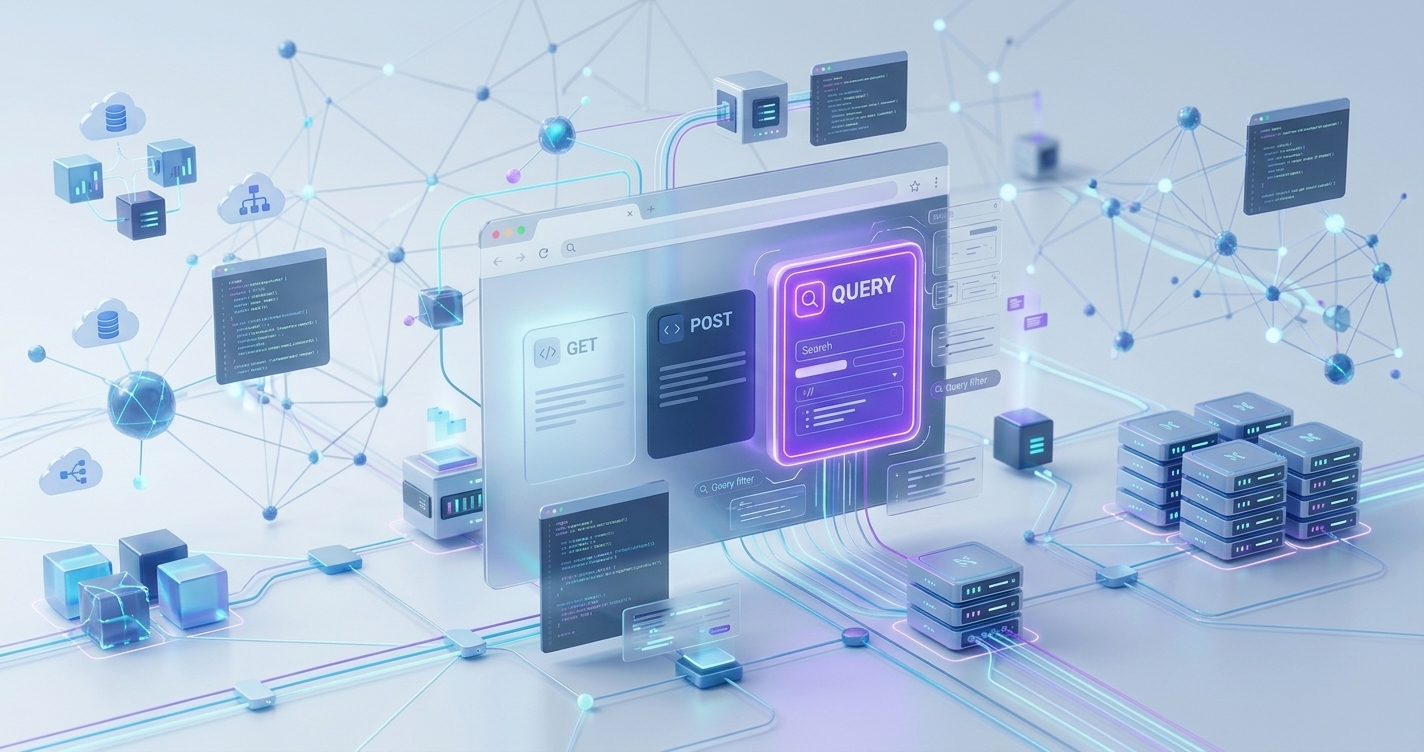
The HTTP QUERY Method: A Complete Developer Guide
The IETF published RFC 10008 in June 2026, standardizing a new HTTP method called `QUERY`. It sits between `GET` (safe, idempotent, cacheable, no body) and POST (supports a body, but not safe or idempotent). `QUERY` is safe, idempotent, cacheable, and accepts a request body. It's the most significant addition to HTTP semantics since `PATCH` in 2010. **Use it when** you need to send complex filter payloads, large structured queries, or any read-only request that doesn't fit cleanly in a URL. **Hold off when** your infrastructure hasn't been tested for support yet. That means CDNs, proxies, load balancers, and API gateways.
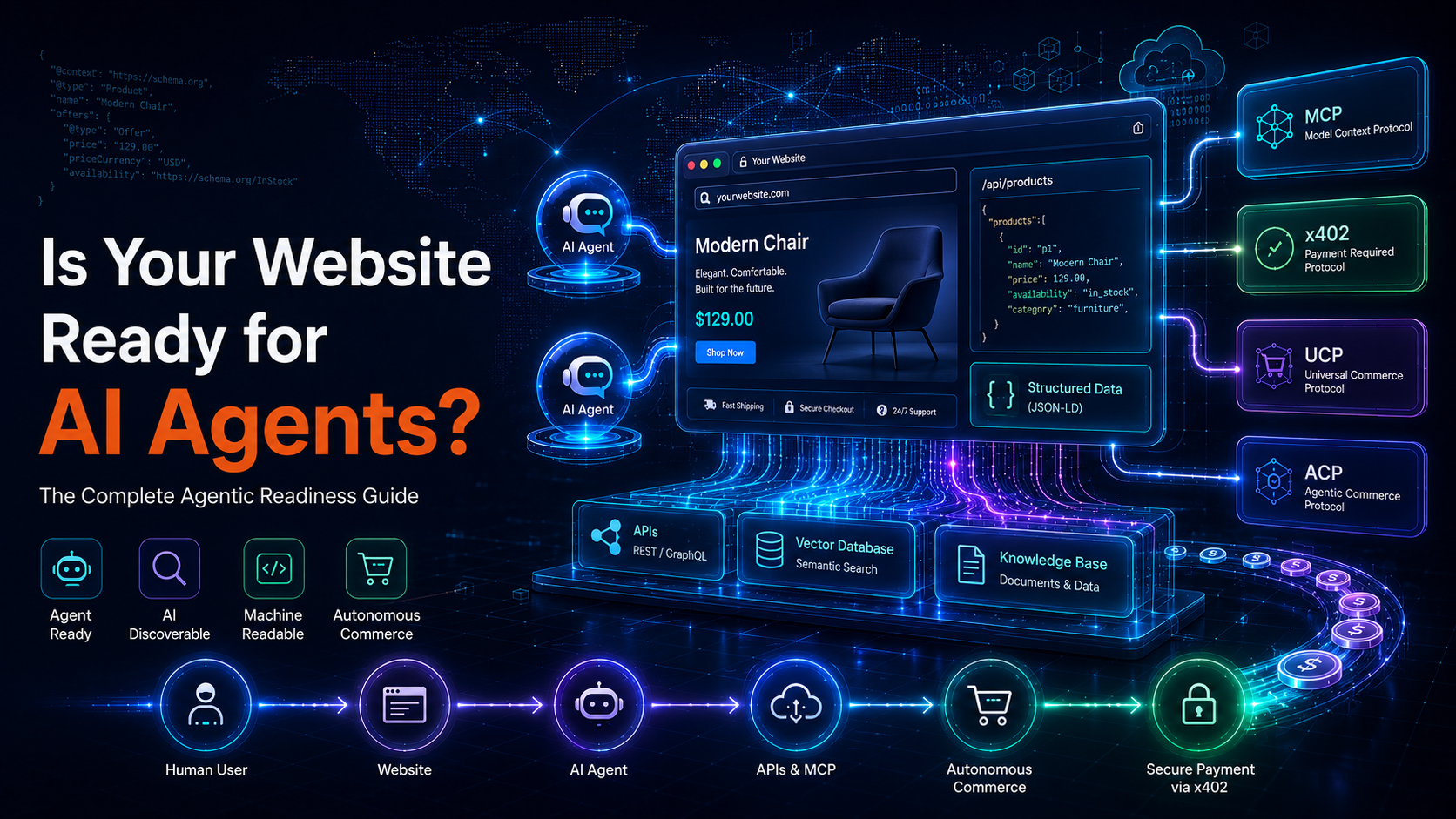
Is Your Website Ready for AI Agents? A Complete Agentic Readiness Guide
Most websites and SaaS platforms are not yet ready for the AI agent era — and that gap is growing fast. To stay visible and functional in an increasingly automated web, you need to adopt technical standards like llms.txt, AI-aware robots.txt directives, Markdown content negotiation, and the Model Context Protocol (MCP). Organizational readiness also matters: address data quality, governance, and ROI tracking before scaling agentic workflows. Check how your site scores right now at [agentic-readiness.xorblin.com](https://agentic-readiness.xorblin.com/).
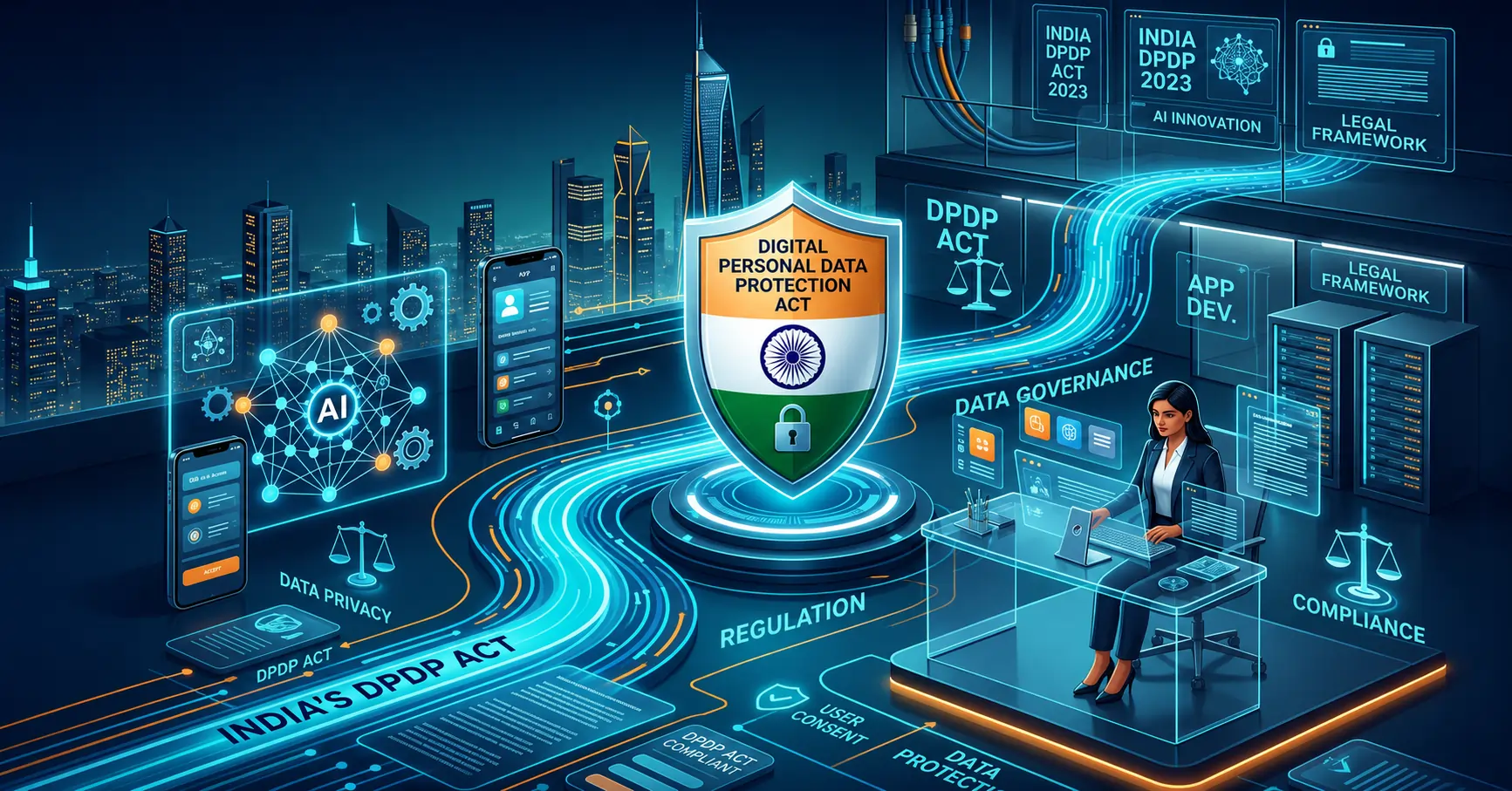
How DPDPA Will Transform AI and App Development in India
The DPDPA applies to startups as well as larger organizations, meaning any business that processes the digital personal data of individuals in India must comply, regardless of its size. The law is set to be fully enforceable from May 13, 2027, when key obligations such as obtaining consent, ensuring data security, and reporting breaches become mandatory. AI companies can generally use publicly available data under certain exemptions, although they must still adhere to copyright laws and platform-specific rules. Penalties for non-compliance can be significant, reaching up to ₹250 crore depending on the severity of the violation. To prepare, businesses should begin immediately by auditing their data practices, updating privacy notices, implementing consent management systems, strengthening security measures, and establishing clear data retention and breach response processes.

Integrating LLMs into Legacy Banking Systems
An empirical analysis of transition frameworks required to securely deploy large language models within highly regulated transactional architectures.


Optimizing Inference Latency in Edge Computing
Methodologies for reducing computational overhead when running transformer-based model inference on localized IoT gateway devices.


Defending Against Prompt Injection Attacks
A structural review of current vulnerabilities in commercial APIs and robust strategies for implementing zero-trust output sanitation.


Automating Healthcare Triage: A 6-Month Review
Examining the efficiency gains and failure modes of deploying an AI-driven triage assistant in a multi-facility metropolitan hospital network.


Manufacturing in the Age of Autonomous Robotics
A strategic overview of how predictive maintenance algorithms and swarm robotics are remodeling factory floor mechanics.


Building the AI-Ready Organizational Culture
Transforming human capital to adapt alongside algorithmic integrations. Key leadership strategies for upskilling and overcoming friction.


Scalable Architecture for Real-Time ML Systems
Deep dive into feature stores, container orchestration, and message queues required to maintain low-latency inference at scale.


Algorithmic Trading: Risk Mitigation Models
Evaluating risk constraints and execution limits in high-frequency trading models during periods of extreme macroeconomic volatility.

Zero-Trust Architectures in AI Data Pipelines
Securing end-to-end data pipelines from ingestion to training. Restricting node-to-node permissions and encrypting datasets at rest.