
A founder I spoke with last year had done everything right. Their brand hit £8M in annual revenue on Shopify Plus, growth looked healthy, and then their operations team quietly started spending fifteen hours a week reconciling orders by hand. The platform couldn't model their subscription-plus-wholesale logic, so people patched the gap with spreadsheets. That's the moment the platform question stops being theoretical. Choosing between Shopify and a custom ecommerce build isn't about which one is "better." It's about which one stops getting in your way as you grow. This guide breaks down where Shopify wins, where custom development pulls ahead, and how to decide based on your actual constraints instead of hype.
Key Takeaways
- Shopify holds about 10.32% of the global ecommerce platform market (Yaguara, 2026) and remains the fastest route to launch for standard retail.
- Custom ecommerce development gives you control over checkout, data, integrations, and architecture that hosted platforms cap by design.
- Total cost of ownership, not sticker price, is the real comparison. Shopify's fees and app stack add up quietly at scale.
- Global ecommerce is valued at $7.8 trillion in 2026 (Mintel), and the brands capturing that spend increasingly need infrastructure built around their model, not the other way round.
- The decision comes down to complexity, scale, and how far your business logic sits from standard retail.
The Numbers Worth Knowing First
Before we get into the tradeoffs, a few figures set the context for why this decision matters more each year.
ECOMMERCE AT A GLANCE (2026)
| Metric | Figure | Source |
|---|---|---|
| Global ecommerce market value | $7.8 trillion | Mintel, 2026 |
| Average cart abandonment rate | 70.19% | Baymard Institute |
| Shopify global platform share | 10.32% | Yaguara, 2026 |
Two of those numbers tell the whole story. The market keeps growing, and roughly seven in ten shoppers still bail before paying. That gap between opportunity and lost revenue is exactly where your platform choice starts to count.
What Shopify Does Well
Give Shopify credit where it's earned. For a huge share of online brands, it's the correct answer, and pretending otherwise would be dishonest.
Shopify gets you selling fast. A team can launch a clean, conversion-ready store in weeks, with hosting, security, PCI compliance, and payment processing handled out of the box. You don't manage servers. You don't patch vulnerabilities. You don't wake up to a checkout outage during a flash sale, because that's Shopify's problem, not yours.
The app ecosystem is genuinely deep. Thousands of integrations cover email, reviews, loyalty, shipping, and analytics, so most common needs have an off-the-shelf answer. For a brand running standard DTC retail, that coverage is hard to beat.
Shopify Plus extends this further with B2B features, custom checkout scripting, and higher throughput for high-volume stores. Plenty of brands scale past £20M on Plus without ever needing to leave.
If your model fits standard retail patterns and you value speed over control, Shopify isn't a compromise. It's the smart default.
What Custom Ecommerce Development Unlocks
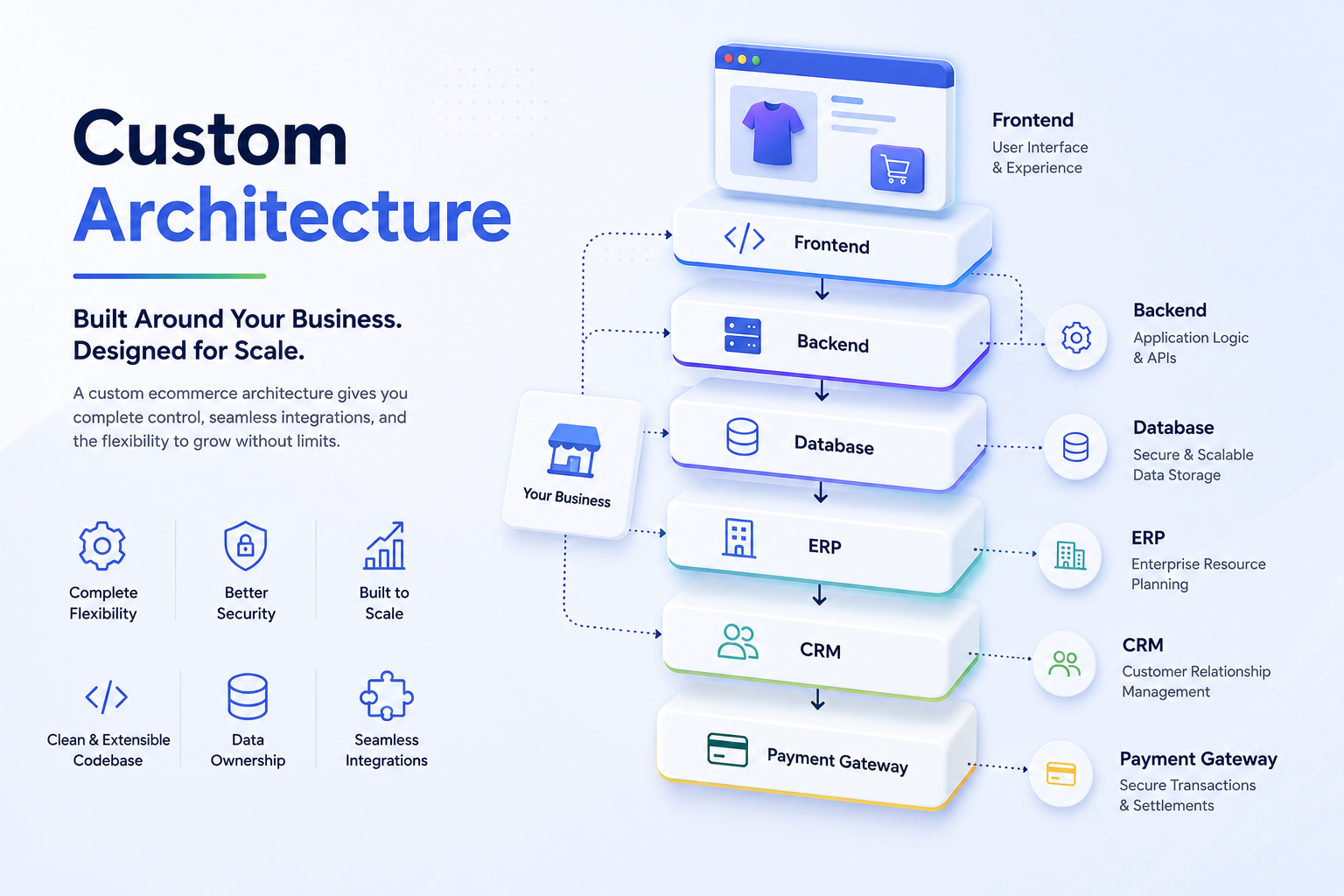
Custom development changes the relationship between your business and your software. Instead of shaping your operations to fit the platform, you build the platform around your operations. That matters most in a few specific areas.
Checkout you actually control
Checkout is where money leaks. The global average cart abandonment rate sits at 70.19% (Baymard Institute), and a meaningful chunk of that comes from friction the platform won't let you remove. Shopify controls its checkout tightly, even on Plus. With a custom build, you own every step: field logic, payment routing, upsell timing, and conditional flows based on cart contents or customer type. When a 1% conversion lift is worth six figures, that control pays for itself.
Integration depth without the tax
Every Shopify app is another subscription, another point of failure, and another data silo. A custom stack lets you connect directly to your ERP, OMS, PIM, or CRM through APIs and middleware you actually own. No app fees stacking month over month. No waiting for a third-party developer to fix a broken sync during peak season.
Data ownership and architecture freedom
On a hosted platform, your data lives inside someone else's model. Custom development gives you full access to structure, store, and act on your data however your business needs. Want an API-first or headless setup that publishes to web, mobile, marketplaces, and retail screens from one backend? That's a custom architecture decision, and it's the kind of thing the SCALE framework's "Stack alignment" check exists to pressure-test before you commit.
Business logic that matches reality
Subscriptions layered with wholesale. Complex bundling. Region-specific tax and fulfillment rules. Custom pricing per account. These are the cases where hosted platforms force workarounds, and workarounds quietly become operational debt.
Shopify vs Custom: The Comparison
| Decision factor | Shopify / Shopify Plus | Custom Ecommerce Development |
|---|---|---|
| Time to launch | Weeks | Three to nine months |
| Upfront cost | Low to moderate | High |
| Ongoing cost | Subscription, transaction fees, app stack | Hosting and maintenance, no platform fees |
| Checkout control | Limited, more on Plus | Full |
| Integration depth | App-dependent | Direct and owned |
| Scalability ceiling | High, but capped by platform rules | Defined by your architecture |
| Data ownership | Within Shopify's model | Complete |
| Maintenance burden | Handled by Shopify | Your team or agency |
| Best fit | Standard retail, fast launch | Complex logic, scale, differentiation |
Total Cost of Ownership: The Honest Math
Sticker price misleads people. Shopify looks cheap on day one and gets expensive quietly.
A Shopify Plus plan starts around £2,000 per month, before you add transaction fees on non-Shopify Payments processing, plus a stack of paid apps that often runs several hundred to a few thousand pounds monthly. At £10M in revenue, transaction fees alone can reach into six figures a year. None of that buys you ownership. You're renting.
Custom development flips the cost curve. You pay more upfront, commonly £75,000 to £250,000+ for a serious build, then your ongoing costs are hosting and maintenance rather than platform tax. Past a certain volume, the custom stack becomes cheaper to run, and every efficiency you build stays yours.
The break-even point depends on your revenue, transaction volume, and how heavily you lean on paid apps. For many brands, it lands somewhere between £5M and £15M in annual revenue.
Compare three-year total cost, not month one. That's where the real difference shows.
Performance and Scalability Tradeoffs
Shopify handles scale well within its own rules. It absorbs traffic spikes, manages infrastructure, and keeps your store up during demand surges without you thinking about it. That reliability has real value.
The ceiling isn't capacity. It's control. You can't tune Shopify's infrastructure the way you'd tune your own, and page performance often depends on how many apps and scripts you've bolted on. Every app adds weight.
A custom build lets you engineer for performance directly: optimized queries, caching strategy, edge delivery, and a front end tuned for Core Web Vitals. For content-heavy or high-traffic stores, that difference shows up in load times and conversion.
Checkout Flexibility and Multi-Region Selling
Selling across the UK, EU, Australia, and beyond adds real complexity. Currencies, tax rules, languages, fulfillment logic, and payment methods all vary by market.
Shopify Markets handles a solid baseline here, and for many brands it's enough. Where it strains is deep localization. Region-specific checkout logic, custom tax handling, and market-specific business rules push against the platform's boundaries.
Custom development treats multi-region as an architecture decision from the start. You define how currencies, catalogs, and fulfillment behave per market, without waiting for a platform feature or a third-party app to catch up.
B2B and Complex Models
B2B is where the gap widens most. Account-specific pricing, quote workflows, credit terms, tiered catalogs, and approval chains are the norm, not the exception.
Shopify Plus has added real B2B capability, and it covers simpler cases well. Once your requirements get genuinely complex, layered pricing rules, deep ERP integration, and custom approval logic, you hit the edges. Adobe Commerce or a custom build usually serves these brands better, because the logic lives in the core rather than in an app trying to reshape the platform.
How Xorblin Helps You Choose and Build
The platform decision is easy to get wrong, and expensive to reverse. At Xorblin, we start by pressure-testing the decision itself before anyone writes code.
We run your business through the SCALE framework, the same method from our pillar guide on choosing an ecommerce agency, to check stack alignment against where you're actually headed. Sometimes the honest answer is "stay on Shopify Plus for now." We'll tell you that, because building custom too early wastes money as surely as building it too late costs growth.
When custom is the right call, we handle the full path: architecture decisions, custom builds, and platform migrations that protect your data and SEO equity. We've moved brands off Magento, extended Shopify Plus past its comfort zone, and stood up headless architectures for teams selling across multiple regions and channels. The goal stays the same every time. Infrastructure that fits your model instead of fighting it.
If you're weighing Shopify against a custom build and can't tell which side of the line you're on, that ambiguity is exactly what a proper evaluation resolves.
Pricing: Realistic Ranges
Numbers vary by market and complexity, but these ranges hold up in practice:
| Build type | Typical range |
|---|---|
| Shopify Plus setup and customization | £15,000 to £60,000 |
| Custom Shopify Plus development | £40,000 to £150,000+ |
| Full custom ecommerce build | £75,000 to £250,000+ |
| Headless / composable architecture | £100,000 to £400,000+ |
Add ongoing costs on top. Shopify's subscription, fees, and apps on one side, custom hosting and maintenance on the other. The right comparison is always total cost over three years, weighed against what each option lets your business do.
Common Mistakes to Avoid
Building custom too early. If standard retail logic fits, custom is over-engineering. Grow on Shopify first.
Staying on Shopify too long. When workarounds and app fees eat real hours and margin, the platform costs more than it saves. Comparing sticker price instead of total cost. Month one is misleading. Model three years.
Ignoring exit terms. Whether you build custom or migrate, own your code, data, and credentials. Renting your own store is the worst outcome.
Conclusion
The Shopify vs custom question rarely has a universal answer, and anyone who gives you one without asking about your model is selling something. Shopify is the right default for speed, simplicity, and standard retail. Custom ecommerce development wins when your business logic, integration needs, or scale push past what a hosted platform will flex around.
Decide based on complexity and total cost over time, not the launch-day price tag. If your team is spending real hours fighting the platform to run normal operations, you've likely already outgrown it. That's the point where owning your infrastructure stops being a luxury and starts being the cheaper path.
If you want a straight answer on which side of the line you're on, run your requirements through a proper evaluation before committing either way.